Showing posts with label Olympus. Show all posts

Saturday, August 10, 2013

Olympus EM-1 details leaked

Details of an unannounced camera from Olympus have been leaked.

The Olympus EM–1 is a compact system camera is expected to be officially announced in the next couple of weeks.

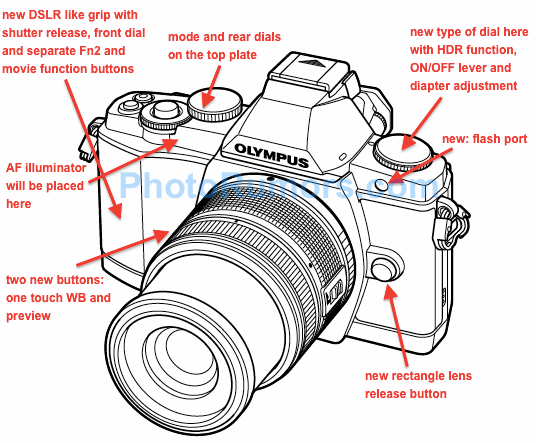
However, details of the camera have been leaked, including a diagram that was produced by someone who claims to be testing the camera.

It shows that while the camera will share many of the same features found in previous Olympus cameras, the EM–1 will feature a newly designed AEL/AFL button and come with a redesigned button placement.

News of the EM–1 leaked earlier this year. However, this is the first time any firm details have been leaked.

Previous speculation has suggested that the EM–1 be a four-thirds format camera and will come with a DSLR like design. It has been compared to the Olympus E-M5, but with a larger grip and an additional control dial.

In addition, it is rumoured to come with a 16 megapixel sensor, 81 autofocus points and a three inch tilting LCD screen.

Official details of the camera are expected in the coming weeks.

Via: Pocket-Lint


View the original article here

Thilina  /  at  4:43 PM  /  No comments

Details of an unannounced camera from Olympus have been leaked.

The Olympus EM–1 is a compact system camera is expected to be officially announced in the next couple of weeks.

However, details of the camera have been leaked, including a diagram that was produced by someone who claims to be testing the camera.

It shows that while the camera will share many of the same features found in previous Olympus cameras, the EM–1 will feature a newly designed AEL/AFL button and come with a redesigned button placement.

News of the EM–1 leaked earlier this year. However, this is the first time any firm details have been leaked.

Previous speculation has suggested that the EM–1 be a four-thirds format camera and will come with a DSLR like design. It has been compared to the Olympus E-M5, but with a larger grip and an additional control dial.

In addition, it is rumoured to come with a 16 megapixel sensor, 81 autofocus points and a three inch tilting LCD screen.

Official details of the camera are expected in the coming weeks.

Via: Pocket-Lint


View the original article here

Posted in: , , Read Complete Article»

Thursday, May 16, 2013

Review: Olympus XZ-10

The Olympus XZ-10 occupies the lucrative premium compact camera space that seems to be ever-growing in the number of options available to consumers.
These cameras offer much more than a bog-standard compact, and certainly much more than a smartphone. Generally offering full manual control, other inviting features include fast aperture lenses and raw format shooting.
Olympus already has the XZ-2 at the very top of its lineup, so this XZ-10 is intended to be the "Lite" version of that camera, with similar specifications in a smaller body, and at a slightly cheaper full price point of £349.99 / US$399.99 / AU$499.

As such, the Olympus XZ-10 is in direct competition with the likes of the Nikon P330 and Canon PowerShot S110, both one step below in their respective company's compact lines. It's also up against the Panasonic Lumix LX7 and, arguably, also travel superzoom compacts such as the Panasonic TZ40.

The Olympus XZ-10 is smaller than the Olympus XZ-2, but still manages to house a 12 million pixel sensor. At 1/2.3 inches, it is physically smaller than the Olympus XZ-2's offering, though.
Along with full manual control, there's also semi-automatic modes such as aperture priority and shutter priority. Fully automatic shooting is also available, along with a range of creative modes such as Photo Story and Art Filters. Raw format shooting is a possibility, too.

Unlike the Canon PowerShot S110, Wi-Fi isn't built into the body itself, but the camera is compatible with Toshiba's FlashAir Wireless LAN SD cards, which enable image sharing between smartphones and tablets, but not remote shooting.
At its widest point, the Olympus XZ-10's lens boasts an f/1.8 aperture. This rises to a still fairly impressive f/2.7 at the telephoto end of the optic. It's a 5x optical zoom lens, with an equivalent focal length of 26-130mm (in 35mm terms).
Like with the Nikon P330, an inbuilt ND filter is integrated to help with exposure control in bright conditions. Digital zooming is also available, with Olympus' super resolution zoom boosting the lens capability up to 10x. Around the base of the lens is a control ring for altering aperture.

The Olympus XZ-10 is equipped with the same True Pic VI processing engine as the latest PEN and OM-D cameras, which helps to facilitate Full HD video recording and high sensitivity shooting. Sensitivity ranges from ISO 100-1600 in the native range, and can be extended up to ISO 6400.
A touch-sensitive, 3-inch, 920k screen is at the back of the camera. You can use this to set the autofocus point or fire the shutter itself. There's no viewfinder, and unlike the Olympus XZ-2, there's no hotshoe or port to attach one, so you'll have to rely on the screen for composition.
The contrast detection focusing system has 35 AF points. Single AF and Super Macro focusing are available. Super Macro promises to enable you to get as close as 1cm from the subject. Fast shooting at up to 5fps is included.

Olympus is well known for its love of creative options, and the Olympus XZ-10 is packed with several. Art filters from the OM-D/PEN series have been brought across, including Cross Process, Dramatic Tone and Key Line.
These can be used within the fully manual and semi-automatic shooting modes, as well as having a dedicated mode on the dial. Each art filter is customisable, with different frames and effects being available for each one.
A new feature, PhotoStory, is also included. This enables you to create montages of a number of images taken in quick succession. These are saved as one JPEG file, and can be customised in a number of different ways. Some editing can be done post-capture, such as resizing and red-eye reduction.

View the original article here
Thilina  /  at  4:16 AM  /  No comments

The Olympus XZ-10 occupies the lucrative premium compact camera space that seems to be ever-growing in the number of options available to consumers.
These cameras offer much more than a bog-standard compact, and certainly much more than a smartphone. Generally offering full manual control, other inviting features include fast aperture lenses and raw format shooting.
Olympus already has the XZ-2 at the very top of its lineup, so this XZ-10 is intended to be the "Lite" version of that camera, with similar specifications in a smaller body, and at a slightly cheaper full price point of £349.99 / US$399.99 / AU$499.

As such, the Olympus XZ-10 is in direct competition with the likes of the Nikon P330 and Canon PowerShot S110, both one step below in their respective company's compact lines. It's also up against the Panasonic Lumix LX7 and, arguably, also travel superzoom compacts such as the Panasonic TZ40.

The Olympus XZ-10 is smaller than the Olympus XZ-2, but still manages to house a 12 million pixel sensor. At 1/2.3 inches, it is physically smaller than the Olympus XZ-2's offering, though.
Along with full manual control, there's also semi-automatic modes such as aperture priority and shutter priority. Fully automatic shooting is also available, along with a range of creative modes such as Photo Story and Art Filters. Raw format shooting is a possibility, too.

Unlike the Canon PowerShot S110, Wi-Fi isn't built into the body itself, but the camera is compatible with Toshiba's FlashAir Wireless LAN SD cards, which enable image sharing between smartphones and tablets, but not remote shooting.
At its widest point, the Olympus XZ-10's lens boasts an f/1.8 aperture. This rises to a still fairly impressive f/2.7 at the telephoto end of the optic. It's a 5x optical zoom lens, with an equivalent focal length of 26-130mm (in 35mm terms).
Like with the Nikon P330, an inbuilt ND filter is integrated to help with exposure control in bright conditions. Digital zooming is also available, with Olympus' super resolution zoom boosting the lens capability up to 10x. Around the base of the lens is a control ring for altering aperture.

The Olympus XZ-10 is equipped with the same True Pic VI processing engine as the latest PEN and OM-D cameras, which helps to facilitate Full HD video recording and high sensitivity shooting. Sensitivity ranges from ISO 100-1600 in the native range, and can be extended up to ISO 6400.
A touch-sensitive, 3-inch, 920k screen is at the back of the camera. You can use this to set the autofocus point or fire the shutter itself. There's no viewfinder, and unlike the Olympus XZ-2, there's no hotshoe or port to attach one, so you'll have to rely on the screen for composition.
The contrast detection focusing system has 35 AF points. Single AF and Super Macro focusing are available. Super Macro promises to enable you to get as close as 1cm from the subject. Fast shooting at up to 5fps is included.

Olympus is well known for its love of creative options, and the Olympus XZ-10 is packed with several. Art filters from the OM-D/PEN series have been brought across, including Cross Process, Dramatic Tone and Key Line.
These can be used within the fully manual and semi-automatic shooting modes, as well as having a dedicated mode on the dial. Each art filter is customisable, with different frames and effects being available for each one.
A new feature, PhotoStory, is also included. This enables you to create montages of a number of images taken in quick succession. These are saved as one JPEG file, and can be customised in a number of different ways. Some editing can be done post-capture, such as resizing and red-eye reduction.

View the original article here

Posted in: , Read Complete Article»

Wednesday, May 15, 2013

Hands-on review: Olympus PEN E-P5

As one of the early innovators in the compact system camera market, Olympus has enjoyed great success with its PEN range of Micro Four Thirds cameras. The retro designs of the PEN series have always appealed to those photographers hankering after the golden age of photography.

The original digital PEN camera, launched all the way back in 2008, was a bit of a game-changer. In terms of camera technology, five years is a long time, so expectations for the fourth generation of the top-of-the-line series are high.

Olympus says it has pretty much gone back to the drawing board for this latest PEN incarnation, but there's no denying that it takes its lead from both the Olympus PEN cameras of old, and the fantastic Olympus OM-D, which made its debut at the beginning of 2012.

Olympus PEN E-P5 review

Inside the Olympus PEN E-P5 is the same 16 million pixel sensor and TruePic VI image sensor as in the Olympus OM-D, which should mean it is capable of the same impressive image quality.

The design is very much inspired by the original analogue PEN, and particularly the black and silver incarnation. It's enough to make anyone looking at the front of the camera do a double take.

Of course, the technology inside the camera far surpasses that of its analogue forebears, and is also a significant jump from the previous Olympus PEN E-P3 camera. There's also enough here to make it, in some respects, a step up from the Olympus OM-D itself.

Olympus PEN E-P5 review

Aside from the same sensor and processor as the Olympus OM-D, the Olympus PEN E-P5 boasts an impressively fast maximum shutter speed of 1/8000 sec. That's something that is currently offered by the likes of professional DSLRs, such as the Nikon D4 and Canon 5D Mark III, so to see it on a CSC priced at just £899 (around AU$1,368 / US$1,399) is quite something.

That fast shutter speed means that not only should the camera be capable of capturing fast-moving subjects, it can also shoot at wide apertures in bright sunlight. Combine that with the new low sensitivity setting of ISO 100, and you've got a recipe for some really creative outdoor work.

Olympus knows that it is a brand enjoyed by the creative photographer, so it's no surprise to see a high number of digital filters, such as Cross Process and Dramatic Tone, making a reappearance on the latest model of the camera. There's also the addition of Focus Peaking, a great tool for those who want to manually focus.

Olympus PEN E-P5 review

Live Time and Live Bulb, the innovative way of shooting long exposures as introduced on the Olympus OM-D, is also found on the Olympus E-P5. This enables you to shoot very long exposures while watching the scene build up on the screen. It takes the guesswork out of this kind of photography, since you can see exactly when to stop the shutter. Olympus has now included a histogram view while using this mode to further assist the user.

A Photo Story mode is also included. This is something that made its debut on the Olympus XZ-10 compact camera and basically enables you to create a montage of photos within the camera itself. Unlike on the Olympus XZ-10, however, each photo that makes up the montage is saved in raw format, as well as a JPG of the finished montage. This means you can use each individual photo at a later date if you want to.

Another feature brought across from the Olympus OM-D is the 5-axis image stabilisation system. Compensating for pitch, rolling, yaw and horizontal and vertical movement, the results of this stabilisation can now be seen in Live View thanks to improvements in battery technology. We'll be especially keen to put this particular feature to the test when a full Olympus PEN E-P5 sample comes in for review.

Olympus PEN E-P5 review

Shooting at up to 9fps is available, but again this has been improved from the Olympus OM-D as this 9fps also includes autofocusing. Add in tracking and the rate is a still pretty impressive 5fps. This is another feature we'll be keen to put through its paces.

Improving the speed of the camera is something Olympus has seemingly worked very hard on. The new Olympus PEN E-P5 boasts a switch-on time of just 0.5 seconds, something that is matched only by the Fuji X-E1 when in its fast switch-on mode. We'll be interested to see how short the shot-to-shot and processing times are, though with the TruePic VI processor onboard, it's likely to be very fast.

Olympus admits it has been late to the Wi-Fi party, but the PEN E-P5 is now fully equipped with this built in. The company claims being late has enabled it to study and improve upon the competitor's offerings. One such feature is the ability to scan a QR code to connect the camera, rather than having the hassle of entering passwords.

Olympus PEN E-P5 review

While the Olympus PEN E-P3 had a fixed touchscreen, the Olympus PEN E-P5 has a tilting, capacitive device. It's the same 3-inch device as found on the Olympus OM-D, so we expect a very responsive and easy to use design. The touchscreen enables the autofocus point to be altered, or the shutter itself fired.

Olympus has used a very similar handling design to the previous incarnation of the camera, but with some very noticeable and welcome improvements on the Olympus PEN E-P5. The chassis is very similar to its predecessor, featuring a removable grip, which is particularly useful when shooting one-handed. A rubberised thumb rest sits at the back of the camera to give a bit of extra purchase too.

Unlike the Olympus PEN E-P3, the Olympus PEN E-P5 uses a switch to turn it on, rather than a button. This might seem like a trivial point, but it enables quicker start-up times. It has been recessed slightly into the body of the camera to prevent accidentally switching it on while in a bag or pocket.

Olympus PEN E-P5 review

Like its predecessor, it uses a capacitive touchscreen, which can be used to set the autofocus point or fire the shutter release. One of the most noticeable improvements is the now tilting screen. It's useful for angling away from any disturbing glare or reflections that might be present - although it didn't seem to suffer too badly when we used it.

It sits remarkably flush against the back of the camera, so much so that you might not even realise it's a tilting device at all. While an articulating screen would be more useful for portrait format shots, it would undoubtedly have added to the bulk of the camera.

At the top of the camera is a mode dial enabling quick transitions between the various modes on offer, such as fully automatic, semi-automatic (aperture or shutter priority) and manual modes. There's also a space here for art modes, scene modes and - new to the PEN range - Photo Story mode.

Olympus PEN E-P5 review

Also on top of the camera is a Function button, which can be customised to suit your particular requirements. The previous version on the Olympus PEN E-P3 required diving into the menu if you wanted to alter ISO or metering, but a new way of working has been introduced onto the Olympus PEN E-P5.

A small switch around the movie record button marked with positions 1 and 2 enables you to alter the function of the two dials at the back and front of the camera. Position 1 controls aperture/shutter speed and exposure compensation (depending on the mode you're shooting in), while flipping to Position 2 changes the modes to ISO and white balance. It's a quick system that should really speed up the basic operation of the camera.

For accessing other commonly used settings, a sort of quick menu can be found by pressing the OK button in the centre of the four-way navigational pad. If you need to delve further to change more complicated settings, you can do this via the main menu. As with other PEN cameras, it can be a little disjointed to use when you're not used to it.

Olympus PEN E-P5 review

It is of course hard to give any concrete opinions about the performance of a camera before we've had a chance to use a full version of it, but we have extremely high hopes for the Olympus PEN E-P5.

The Olympus PEN E-P3 was an extremely capable camera in its own right, but putting the proven excellent Olympus OM-D sensor inside the new, even-more-retro styled body is very likely to be a winning combination - dare we say it, even better than the OM-D itself.

We've already seen how that incredible sensor can be used to good effect in both the Olympus PEN E-PL5 and the Olympus PEN E-PM2, so to see it in the top of the line PEN CSC is very welcome.

Olympus PEN E-P5 review

Olympus promises that the 5-axis image stabilisation system has also been improved, so we'll be very keen to put that to the test when a full sample arrives.

We'll also be keen to put the 1/8000 second shutter speed through its paces in capturing very fast action. It's incredibly rare for a camera at this price point to be capable of such a thing, so we're hoping it proves to be a solid performer.

The Olympus PEN E-P5 is a very exciting camera, and with 2013 being a comparatively quiet year for launches compared with 2012, we think it could possibly be an early contender for best camera of the year.

We already know what the sensor is capable of, and with that stylish body for good measure, we think this could be a big seller. The only drawback at the moment could be the price, making this one of the most expensive compact system cameras on the market, putting it in the same league as high-end cameras such as the Sony NEX-7, Fujifilm X-E1 and even its own semi-sibling, the Olympus OM-D.

For existing PEN owners, even those with an Olympus PEN E-P3, this looks like it will be a significant enough step up to be worthy of consideration for upgrade, while Olympus OM-D owners might even consider switching allegiance if they're not too bothered about the in-built viewfinder.

Those who do care for viewfinders will find themselves either having to go without or shelling out for the external device, which while very good, is an expensive extra that might push the price up a little too high. With the excellent screen, though, it'd be worth trying to live without it.

We'll keep you updated as soon as we can about this very promising addition to the PEN series lineup.


View the original article here
Thilina  /  at  4:27 PM  /  No comments

As one of the early innovators in the compact system camera market, Olympus has enjoyed great success with its PEN range of Micro Four Thirds cameras. The retro designs of the PEN series have always appealed to those photographers hankering after the golden age of photography.

The original digital PEN camera, launched all the way back in 2008, was a bit of a game-changer. In terms of camera technology, five years is a long time, so expectations for the fourth generation of the top-of-the-line series are high.

Olympus says it has pretty much gone back to the drawing board for this latest PEN incarnation, but there's no denying that it takes its lead from both the Olympus PEN cameras of old, and the fantastic Olympus OM-D, which made its debut at the beginning of 2012.

Olympus PEN E-P5 review

Inside the Olympus PEN E-P5 is the same 16 million pixel sensor and TruePic VI image sensor as in the Olympus OM-D, which should mean it is capable of the same impressive image quality.

The design is very much inspired by the original analogue PEN, and particularly the black and silver incarnation. It's enough to make anyone looking at the front of the camera do a double take.

Of course, the technology inside the camera far surpasses that of its analogue forebears, and is also a significant jump from the previous Olympus PEN E-P3 camera. There's also enough here to make it, in some respects, a step up from the Olympus OM-D itself.

Olympus PEN E-P5 review

Aside from the same sensor and processor as the Olympus OM-D, the Olympus PEN E-P5 boasts an impressively fast maximum shutter speed of 1/8000 sec. That's something that is currently offered by the likes of professional DSLRs, such as the Nikon D4 and Canon 5D Mark III, so to see it on a CSC priced at just £899 (around AU$1,368 / US$1,399) is quite something.

That fast shutter speed means that not only should the camera be capable of capturing fast-moving subjects, it can also shoot at wide apertures in bright sunlight. Combine that with the new low sensitivity setting of ISO 100, and you've got a recipe for some really creative outdoor work.

Olympus knows that it is a brand enjoyed by the creative photographer, so it's no surprise to see a high number of digital filters, such as Cross Process and Dramatic Tone, making a reappearance on the latest model of the camera. There's also the addition of Focus Peaking, a great tool for those who want to manually focus.

Olympus PEN E-P5 review

Live Time and Live Bulb, the innovative way of shooting long exposures as introduced on the Olympus OM-D, is also found on the Olympus E-P5. This enables you to shoot very long exposures while watching the scene build up on the screen. It takes the guesswork out of this kind of photography, since you can see exactly when to stop the shutter. Olympus has now included a histogram view while using this mode to further assist the user.

A Photo Story mode is also included. This is something that made its debut on the Olympus XZ-10 compact camera and basically enables you to create a montage of photos within the camera itself. Unlike on the Olympus XZ-10, however, each photo that makes up the montage is saved in raw format, as well as a JPG of the finished montage. This means you can use each individual photo at a later date if you want to.

Another feature brought across from the Olympus OM-D is the 5-axis image stabilisation system. Compensating for pitch, rolling, yaw and horizontal and vertical movement, the results of this stabilisation can now be seen in Live View thanks to improvements in battery technology. We'll be especially keen to put this particular feature to the test when a full Olympus PEN E-P5 sample comes in for review.

Olympus PEN E-P5 review

Shooting at up to 9fps is available, but again this has been improved from the Olympus OM-D as this 9fps also includes autofocusing. Add in tracking and the rate is a still pretty impressive 5fps. This is another feature we'll be keen to put through its paces.

Improving the speed of the camera is something Olympus has seemingly worked very hard on. The new Olympus PEN E-P5 boasts a switch-on time of just 0.5 seconds, something that is matched only by the Fuji X-E1 when in its fast switch-on mode. We'll be interested to see how short the shot-to-shot and processing times are, though with the TruePic VI processor onboard, it's likely to be very fast.

Olympus admits it has been late to the Wi-Fi party, but the PEN E-P5 is now fully equipped with this built in. The company claims being late has enabled it to study and improve upon the competitor's offerings. One such feature is the ability to scan a QR code to connect the camera, rather than having the hassle of entering passwords.

Olympus PEN E-P5 review

While the Olympus PEN E-P3 had a fixed touchscreen, the Olympus PEN E-P5 has a tilting, capacitive device. It's the same 3-inch device as found on the Olympus OM-D, so we expect a very responsive and easy to use design. The touchscreen enables the autofocus point to be altered, or the shutter itself fired.

Olympus has used a very similar handling design to the previous incarnation of the camera, but with some very noticeable and welcome improvements on the Olympus PEN E-P5. The chassis is very similar to its predecessor, featuring a removable grip, which is particularly useful when shooting one-handed. A rubberised thumb rest sits at the back of the camera to give a bit of extra purchase too.

Unlike the Olympus PEN E-P3, the Olympus PEN E-P5 uses a switch to turn it on, rather than a button. This might seem like a trivial point, but it enables quicker start-up times. It has been recessed slightly into the body of the camera to prevent accidentally switching it on while in a bag or pocket.

Olympus PEN E-P5 review

Like its predecessor, it uses a capacitive touchscreen, which can be used to set the autofocus point or fire the shutter release. One of the most noticeable improvements is the now tilting screen. It's useful for angling away from any disturbing glare or reflections that might be present - although it didn't seem to suffer too badly when we used it.

It sits remarkably flush against the back of the camera, so much so that you might not even realise it's a tilting device at all. While an articulating screen would be more useful for portrait format shots, it would undoubtedly have added to the bulk of the camera.

At the top of the camera is a mode dial enabling quick transitions between the various modes on offer, such as fully automatic, semi-automatic (aperture or shutter priority) and manual modes. There's also a space here for art modes, scene modes and - new to the PEN range - Photo Story mode.

Olympus PEN E-P5 review

Also on top of the camera is a Function button, which can be customised to suit your particular requirements. The previous version on the Olympus PEN E-P3 required diving into the menu if you wanted to alter ISO or metering, but a new way of working has been introduced onto the Olympus PEN E-P5.

A small switch around the movie record button marked with positions 1 and 2 enables you to alter the function of the two dials at the back and front of the camera. Position 1 controls aperture/shutter speed and exposure compensation (depending on the mode you're shooting in), while flipping to Position 2 changes the modes to ISO and white balance. It's a quick system that should really speed up the basic operation of the camera.

For accessing other commonly used settings, a sort of quick menu can be found by pressing the OK button in the centre of the four-way navigational pad. If you need to delve further to change more complicated settings, you can do this via the main menu. As with other PEN cameras, it can be a little disjointed to use when you're not used to it.

Olympus PEN E-P5 review

It is of course hard to give any concrete opinions about the performance of a camera before we've had a chance to use a full version of it, but we have extremely high hopes for the Olympus PEN E-P5.

The Olympus PEN E-P3 was an extremely capable camera in its own right, but putting the proven excellent Olympus OM-D sensor inside the new, even-more-retro styled body is very likely to be a winning combination - dare we say it, even better than the OM-D itself.

We've already seen how that incredible sensor can be used to good effect in both the Olympus PEN E-PL5 and the Olympus PEN E-PM2, so to see it in the top of the line PEN CSC is very welcome.

Olympus PEN E-P5 review

Olympus promises that the 5-axis image stabilisation system has also been improved, so we'll be very keen to put that to the test when a full sample arrives.

We'll also be keen to put the 1/8000 second shutter speed through its paces in capturing very fast action. It's incredibly rare for a camera at this price point to be capable of such a thing, so we're hoping it proves to be a solid performer.

The Olympus PEN E-P5 is a very exciting camera, and with 2013 being a comparatively quiet year for launches compared with 2012, we think it could possibly be an early contender for best camera of the year.

We already know what the sensor is capable of, and with that stylish body for good measure, we think this could be a big seller. The only drawback at the moment could be the price, making this one of the most expensive compact system cameras on the market, putting it in the same league as high-end cameras such as the Sony NEX-7, Fujifilm X-E1 and even its own semi-sibling, the Olympus OM-D.

For existing PEN owners, even those with an Olympus PEN E-P3, this looks like it will be a significant enough step up to be worthy of consideration for upgrade, while Olympus OM-D owners might even consider switching allegiance if they're not too bothered about the in-built viewfinder.

Those who do care for viewfinders will find themselves either having to go without or shelling out for the external device, which while very good, is an expensive extra that might push the price up a little too high. With the excellent screen, though, it'd be worth trying to live without it.

We'll keep you updated as soon as we can about this very promising addition to the PEN series lineup.


View the original article here

Posted in: , , Read Complete Article»

Monday, May 13, 2013

Review: Olympus TG-2

The new Olympus TG-2, which replaces the Olympus TG-1, has all the usual tough credentials. It's waterproof down to 15m (49ft), shockproof for drops from up to 2m (6.6ft), freezeproof down to -10C (14F) and crushproof to 100kg (22lbs).

The only one of these features to be enhanced above the Olympus TG-1's spec is the waterproofing, since the Olympus TG-2 can be used 3m deeper underwater than the Olympus TG-1 could.

Like the Olympus TG-1, the Olympus TG-2 has a 1/2.3-inch CMOS sensor with 12 million effective pixels, a sensitivity range of ISO 100-6400, a 3-inch 610,000-dot OLED screen and a 4x zoom lens with a focal length equivalent of 25-100mm.

Olympus TG-2 review

As with the Olympus TG-1, one of the most exciting aspects of the Olympus TG-2's lens is that it has an aperture range of f/2-4.9. This means that at the shortest focal length a wide aperture is available, which enables you to use fast shutter speeds when light levels fall.

However, in an improvement over the Olympus TG-1, the Olympus TG-2 has aperture priority mode available, which means that as the photographer, you can actually chose which aperture to use if you want. As you might expect with a compact camera, the choice of aperture settings is rather limited, with just three being available at any given focal length.

Nevertheless, this aperture control gives the Olympus TG-2 extra appeal to enthusiast photographers who want to be able to blur backgrounds occasionally. Less experienced photographers, however, will be pleased to learn that there are a collection of fully automated scene modes on hand, along with Intelligent Auto (iA) mode.

Olympus TG-2 review

There's also a Microscope Mode that effectively boosts the zoom to 200mm (35mm equivalent) and enables you to shoot from as close as 1cm.

Modern extras include GPS technology and an electronic compass built-in to record where you take your pictures, along with FlashAir card compatibility to enable wireless sharing of images on social media via your smartphone.

It's also possible to shoot Full HD movies with stereo sound and record video at up to 240fps (frames per second) for slow motion playback.

Olympus TG-2 review

Olympus clearly looked after the mould for the Olympus TG-1, since it appears to have been used for the Olympus TG-2 as well. As before the camera feel nice and solid, with a reasonable weight to it.

Dual locked covers protect the battery and memory card ports, as well as the cable connections. Although these are a bit fiddly to operate they at least mean that you, or the smaller members of the family, are unlikely to accidentally open any of the doors when the camera is wet or covered in mud.

While the controls are reasonably sized for use in 'normal' conditions, they are rather fiddly to use when wearing gloves. As a result, if you are skiing it's likely that you will have to get a cold hand to press the buttons, and if you're in a wetsuit then you may get quite frustrated trying to make settings changes.

Olympus TG-2 review

Olympus has again incorporated its Tap Control mechanism that enables settings to be adjusted and images taken using taps on the top, bottom, sides and back of the camera. We found using it a rather frustrating experience with mixed success.

Because the Olympus TG-2 doesn't have a viewfinder, images must be composed using the 3-inch screen on the back of the camera. Unfortunately, this makes composition almost guesswork in very bright conditions such as a ski slope or on a sunlit beach - just when you want to use a tough camera.

In more standard conditions, it is possible to see the scene and compose images more easily, but the settings options on the right of the screen can be hard to read outdoors.

Olympus TG-2 review

The Olympus TG-2 is compatible with Olympus's Fisheye and Teleconverter lenses. Fitting either of these converters involves removing a ring around the lens. We found this trim quite prone to accidental removal when the camera is in a bag or pocket.

As we would expect from an Olympus camera, the Olympus TG-2 produces images with nice, natural colours that have a bit of punch but not too much contrast.

On the whole, images are also well exposed when the camera is left to its own devices or the appropriate Scene modes are selected.

Olympus TG-2 review

The focusing is also good, although it's not possible to select an AF point away from the centre of the frame. When Face Recognition is activated, the camera quickly latches onto and focuses on a face.

Our tests reveal that the Olympus TG-2 produces good quality images in a range of conditions. However, at the risk of nit-picking, close inspection reveals that some details in out of focus areas are a little smudged, even in images taken at the lowest sensitivity settings.

In some cases this loss of detail is apparent when images are sized to make A4 (US letter size) prints - if you know what you're looking for.

Olympus TG-2 review

We suspect that the vast majority of Olympus TG-2 users will be more than happy with the image quality that the camera turns out, but because it has an aperture priority mode it may find itself in the hands of photographers who are more used to scrutinising shots from DSLRs.

The results of our labs tests for noise and dynamic range, image quality and resolution, and sensitivity are all on the following pages, along with sample images from the Olympus TG-2.

Comparing our resolution chart images from the Olympus TG-2 with those from other rugged cameras such as the Panasonic FT4 and Nikon AW100 also reveals that it can't resolve quite as much detail.

Olympus TG-2 review

This is interesting, because it conflicts a little with our signal to noise ratio results that show the Olympus camera is a good performer by comparison. It suggests that Olympus has masked image noise more than the other cameras and the in-camera processing manages to maintain a high image signal.

In many respects the Olympus TG-2 is a good performer. It produces sharp, well-exposed images with excellent colours in a range of situations.

It also enables you to take images in situations that just a few years ago were out of bounds for most photographers.

However, the Olympus TG-2 may not be the camera to buy if you are looking to make lots of large prints, since some fine details look smudged.

The Olympus TG-2 offers good control over exposure for a tough camera and it produces images with great colour and plenty of impact.

The loss of detail in out of focus areas limits the size at which images can be viewed or printed.

As with other GPS-enabled cameras, using the GPS technology reduces battery life considerably, so most users are likely to turn it off.

However, the main issue that we have with the Olympus TG-2 is that the screen is hard to see in the very conditions that you are most likely to want to use a rugged camera - on the beach or in snow.

The Olympus TG-2 is pretty good example of a tough camera, but like several others, the controls are a bit too fiddly for use with gloved hands. The screen also suffers from reflections in very bright light, which is a problem if you want to use it on skiing or beach holidays.

Its image quality is good, provided you don't scrutinise out of focus areas too closely.


View the original article here

Thilina  /  at  9:57 AM  /  No comments

The new Olympus TG-2, which replaces the Olympus TG-1, has all the usual tough credentials. It's waterproof down to 15m (49ft), shockproof for drops from up to 2m (6.6ft), freezeproof down to -10C (14F) and crushproof to 100kg (22lbs).

The only one of these features to be enhanced above the Olympus TG-1's spec is the waterproofing, since the Olympus TG-2 can be used 3m deeper underwater than the Olympus TG-1 could.

Like the Olympus TG-1, the Olympus TG-2 has a 1/2.3-inch CMOS sensor with 12 million effective pixels, a sensitivity range of ISO 100-6400, a 3-inch 610,000-dot OLED screen and a 4x zoom lens with a focal length equivalent of 25-100mm.

Olympus TG-2 review

As with the Olympus TG-1, one of the most exciting aspects of the Olympus TG-2's lens is that it has an aperture range of f/2-4.9. This means that at the shortest focal length a wide aperture is available, which enables you to use fast shutter speeds when light levels fall.

However, in an improvement over the Olympus TG-1, the Olympus TG-2 has aperture priority mode available, which means that as the photographer, you can actually chose which aperture to use if you want. As you might expect with a compact camera, the choice of aperture settings is rather limited, with just three being available at any given focal length.

Nevertheless, this aperture control gives the Olympus TG-2 extra appeal to enthusiast photographers who want to be able to blur backgrounds occasionally. Less experienced photographers, however, will be pleased to learn that there are a collection of fully automated scene modes on hand, along with Intelligent Auto (iA) mode.

Olympus TG-2 review

There's also a Microscope Mode that effectively boosts the zoom to 200mm (35mm equivalent) and enables you to shoot from as close as 1cm.

Modern extras include GPS technology and an electronic compass built-in to record where you take your pictures, along with FlashAir card compatibility to enable wireless sharing of images on social media via your smartphone.

It's also possible to shoot Full HD movies with stereo sound and record video at up to 240fps (frames per second) for slow motion playback.

Olympus TG-2 review

Olympus clearly looked after the mould for the Olympus TG-1, since it appears to have been used for the Olympus TG-2 as well. As before the camera feel nice and solid, with a reasonable weight to it.

Dual locked covers protect the battery and memory card ports, as well as the cable connections. Although these are a bit fiddly to operate they at least mean that you, or the smaller members of the family, are unlikely to accidentally open any of the doors when the camera is wet or covered in mud.

While the controls are reasonably sized for use in 'normal' conditions, they are rather fiddly to use when wearing gloves. As a result, if you are skiing it's likely that you will have to get a cold hand to press the buttons, and if you're in a wetsuit then you may get quite frustrated trying to make settings changes.

Olympus TG-2 review

Olympus has again incorporated its Tap Control mechanism that enables settings to be adjusted and images taken using taps on the top, bottom, sides and back of the camera. We found using it a rather frustrating experience with mixed success.

Because the Olympus TG-2 doesn't have a viewfinder, images must be composed using the 3-inch screen on the back of the camera. Unfortunately, this makes composition almost guesswork in very bright conditions such as a ski slope or on a sunlit beach - just when you want to use a tough camera.

In more standard conditions, it is possible to see the scene and compose images more easily, but the settings options on the right of the screen can be hard to read outdoors.

Olympus TG-2 review

The Olympus TG-2 is compatible with Olympus's Fisheye and Teleconverter lenses. Fitting either of these converters involves removing a ring around the lens. We found this trim quite prone to accidental removal when the camera is in a bag or pocket.

As we would expect from an Olympus camera, the Olympus TG-2 produces images with nice, natural colours that have a bit of punch but not too much contrast.

On the whole, images are also well exposed when the camera is left to its own devices or the appropriate Scene modes are selected.

Olympus TG-2 review

The focusing is also good, although it's not possible to select an AF point away from the centre of the frame. When Face Recognition is activated, the camera quickly latches onto and focuses on a face.

Our tests reveal that the Olympus TG-2 produces good quality images in a range of conditions. However, at the risk of nit-picking, close inspection reveals that some details in out of focus areas are a little smudged, even in images taken at the lowest sensitivity settings.

In some cases this loss of detail is apparent when images are sized to make A4 (US letter size) prints - if you know what you're looking for.

Olympus TG-2 review

We suspect that the vast majority of Olympus TG-2 users will be more than happy with the image quality that the camera turns out, but because it has an aperture priority mode it may find itself in the hands of photographers who are more used to scrutinising shots from DSLRs.

The results of our labs tests for noise and dynamic range, image quality and resolution, and sensitivity are all on the following pages, along with sample images from the Olympus TG-2.

Comparing our resolution chart images from the Olympus TG-2 with those from other rugged cameras such as the Panasonic FT4 and Nikon AW100 also reveals that it can't resolve quite as much detail.

Olympus TG-2 review

This is interesting, because it conflicts a little with our signal to noise ratio results that show the Olympus camera is a good performer by comparison. It suggests that Olympus has masked image noise more than the other cameras and the in-camera processing manages to maintain a high image signal.

In many respects the Olympus TG-2 is a good performer. It produces sharp, well-exposed images with excellent colours in a range of situations.

It also enables you to take images in situations that just a few years ago were out of bounds for most photographers.

However, the Olympus TG-2 may not be the camera to buy if you are looking to make lots of large prints, since some fine details look smudged.

The Olympus TG-2 offers good control over exposure for a tough camera and it produces images with great colour and plenty of impact.

The loss of detail in out of focus areas limits the size at which images can be viewed or printed.

As with other GPS-enabled cameras, using the GPS technology reduces battery life considerably, so most users are likely to turn it off.

However, the main issue that we have with the Olympus TG-2 is that the screen is hard to see in the very conditions that you are most likely to want to use a rugged camera - on the beach or in snow.

The Olympus TG-2 is pretty good example of a tough camera, but like several others, the controls are a bit too fiddly for use with gloved hands. The screen also suffers from reflections in very bright light, which is a problem if you want to use it on skiing or beach holidays.

Its image quality is good, provided you don't scrutinise out of focus areas too closely.


View the original article here

Posted in: , Read Complete Article»
Copyright © 2013 Tech Reviews. WP Theme-junkie converted by BloggerTheme9
Blogger templates. Proudly Powered by Blogger.